
What Robert Marcellus Really Sounded Like and Why Your Teeth Have More to Do With It Than You Think
May 05, 2026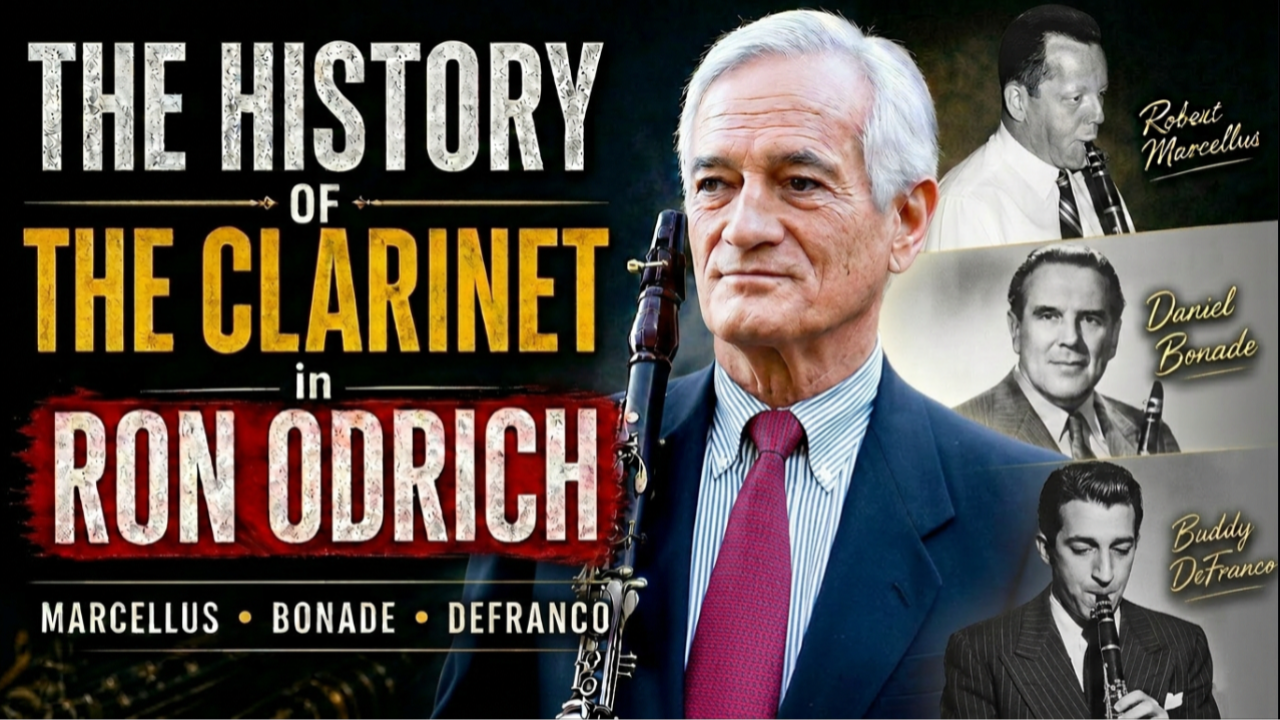
What Robert Marcellus Really Sounded Like and Why Your Teeth Have More to Do With It Than You Think
There is a story Ron Odrich tells about a lesson with Daniel Bonade that most clarinet players have never heard.
Ron was playing through a Rose etude. He had a Melior mouthpiece, the kind he describes as basically a door stop. He was doing well enough that Bonade was nodding along, which was, as Ron puts it, completely unheard of.
Then Bonade reached over, took the clarinet, and played the entire etude himself.
Ron stood two feet away and listened. When Bonade handed the instrument back, Ron said: That's it. I'm done.
He didn't mean forever, but just for the day. It was a challenge to want to play the clarinet again that day after hearing what Bonade could do with a mouthpiece Ron considered nearly unplayable. It is the same feeling Phil Woods described after handing Charlie Parker his own saxophone and reed and mouthpiece during a club gig in Manhattan, only to hear Bird sound like God with equipment Phil had spent the whole night complaining about.
It is a lesson that goes deeper than inspiration. It is a lesson about the source of great sound.
Who Is Dr. Ron Odrich
Dr. Ron Odrich is not a name that appears in every clarinet textbook, but among the people who knew the American clarinet tradition from the inside, he is considered one of the most knowledgeable figures alive. He is a world-renowned periodontist, a former member of the Airmen of Note, a close friend and student of Buddy DeFranco, and a man who studied privately with both Robert Marcellus and Daniel Bonade.
He is also, as he would be the first to tell you, the kind of person to whom remarkable things just seem to happen.
In the first episode of a four-part series on the Clarinet Ninja Podcast, host Jay Hasler sat down with Ron to trace the full arc of his musical education, from his first teacher in the Italian immigrant community of New York to the practice rooms of Bolling Air Force Base in Washington D.C.
The First Teacher and the Most Beautiful Sound
Ron's first clarinet teacher was not actually a clarinetist. Sal Amato was a virtuosic flutist from Naples who had come to the United States and discovered, as so many studio musicians of that era did, that doubling was where the real income was. He became a phenomenal doubler and in the process developed what Ron still considers the most beautiful clarinet sound he has ever heard from anyone.
That sound planted something in Ron that years of study with some of the finest players in American history never fully displaced.
From Sal Amato, Ron went to Jimmy Abato, a friend of his father's in the New York studio scene. Then, after auditioning for and joining the Airmen of Note, he found himself at Bolling Air Force Base and within orbit of Robert Marcellus, who was then serving as principal clarinet of the National Symphony.
Three Years With Robert Marcellus
From 1950 to 1953, Ron studied privately with Marcellus. He describes those years as the period when he actually learned how to play the clarinet, spending three or four hours a day in practice with Marcellus as his guide.
Marcellus was, by Ron's account, extraordinarily formal. There was no small talk. No how are you doing. It was: what are we working on today. He was interested only in what you wanted to achieve and how to get you there.
When Ron told him he wanted to develop the best possible clarinet sound and play jazz, Marcellus accepted that without judgment. He handed Ron a list of recordings to buy and told him to go to Sam Goody's in New York. The first thing on the list was Bonade playing Scheherazade. Ron bought it, listened to it, and said, out loud, oh my God.
He also attended Marcellus's performances with the National Symphony as often as he could, sometimes going with Walt Levinsky just to sit in Constitution Hall and hear that sound carry across the room.
The Benny Goodman Phone Call
During one of Ron's lessons, the phone rang. Bonade excused himself briefly, picked it up without leaving the room, and said: Yes. No, Benny. No. No, I will not. No, Benny. No, thank you. Then he hung up, looked at Ron, and explained: Benny Goodman. He never does what I tell him to do anyway.
Ron tells this story with the matter-of-fact delivery of someone who has spent a lifetime having extraordinary things happen to him and simply accepted that this is how his life works.
Meeting Buddy DeFranco
Ron had been listening to Buddy DeFranco on records before he ever met him. His father, a studio cellist with a wide musical circle, occasionally hosted musicians at home on Sundays. One day his father told him that the man on those records sometimes came by. Did Ron want to meet him?
Of course he did. DeFranco came over, heard Ron playing, and a friendship and mentorship developed that ran parallel to his classical studies for years. Ron wanted both worlds, and DeFranco opened one of them to him.
Daniel Bonade and the Language of Sound
After leaving the Air Force, Ron studied with Daniel Bonade for several years. Bonade was, as most clarinet students know, the foundational figure of the American orchestral clarinet tradition, though Ron notes with amusement that calling it the American sound is a bit ironic given that Bonade was French.
Ron's analysis of why national clarinet schools sound different from one another is unlike anything you will read in a standard pedagogy text. As both a clarinetist and a periodontist who taught periodontics in Italy and spent time listening to Italian wind players, he noticed something: there are vowel sounds in English and French that Italian speakers simply cannot make. The neutral vowel, the soft unstressed syllable that English speakers produce without thinking, is essentially inaccessible to native Italian speakers at a physical level.
Since the mouth is a resonating chamber for single-reed instruments, and since the reed vibrates inside that chamber, the habitual positions of the tongue, soft palate, and lips that a language builds into a person are also the positions that shape their instrumental sound. The French clarity and fluidity that Bonade carried with him, Ron argues, came partly from the specific resonances his native language had trained into his mouth from childhood.
The Dentist and the Denture
The most clinically precise and original section of the conversation involves Marcellus's teeth, or rather, his lack of them.
Robert Marcellus was a Type 1 diabetic from childhood. People with that condition, Ron explains as a periodontist, typically experience severe periodontal complications and often lose their teeth early. Marcellus lost his upper teeth and wore a full upper denture.
Playing clarinet with a full upper denture requires something that most players never have to think about: you must use your upper lip to actively hold the denture against the palate, sealing it against the soft tissue to prevent air from getting behind it. If air escapes between the denture base and the palate, the denture comes loose and you cannot play or speak.
To achieve that seal, you press up and back with the upper lip. That action raises the soft palate. A raised soft palate creates exactly what teachers describe when they say to stifle a yawn while playing: a large, dome-shaped resonating chamber inside the mouth.
Ron's conclusion is that Marcellus's denture, which would seem like a liability for any wind player, was in fact the mechanism that produced his most celebrated characteristic: that large, soaring, room-filling sound that his son Mark, at age twelve with no frame of reference, heard at a Carnegie Hall rehearsal and could not stop asking about.
What the Equipment Cannot Do
Both the Marcellus story and the Phil Woods story arrive at the same place. The equipment, the mouthpiece, the reed, the barrel, the clarinet itself, is in service to the player. It does not make the sound. The player makes the sound, with everything that years of study, language, anatomy, and intentional listening have built into them.
Ron Odrich spent three years with Marcellus, studied with Bonade, grew up around studio musicians, befriended DeFranco, and spent decades thinking about the interior of the human mouth as both a clinician and a musician. The sound he is describing when he talks about these players is not a mystery. It is the accumulated result of all of that.
Listen to Episode 1 of the Clarinet Ninja Podcast now.
Three more episodes with Dr. Ron Odrich are coming, and if this one is any indication, you will not want to miss a single one.