
The Science of Clarinet Sound - Ron Odrich on the Clarinet Ninja Podcast
May 18, 2026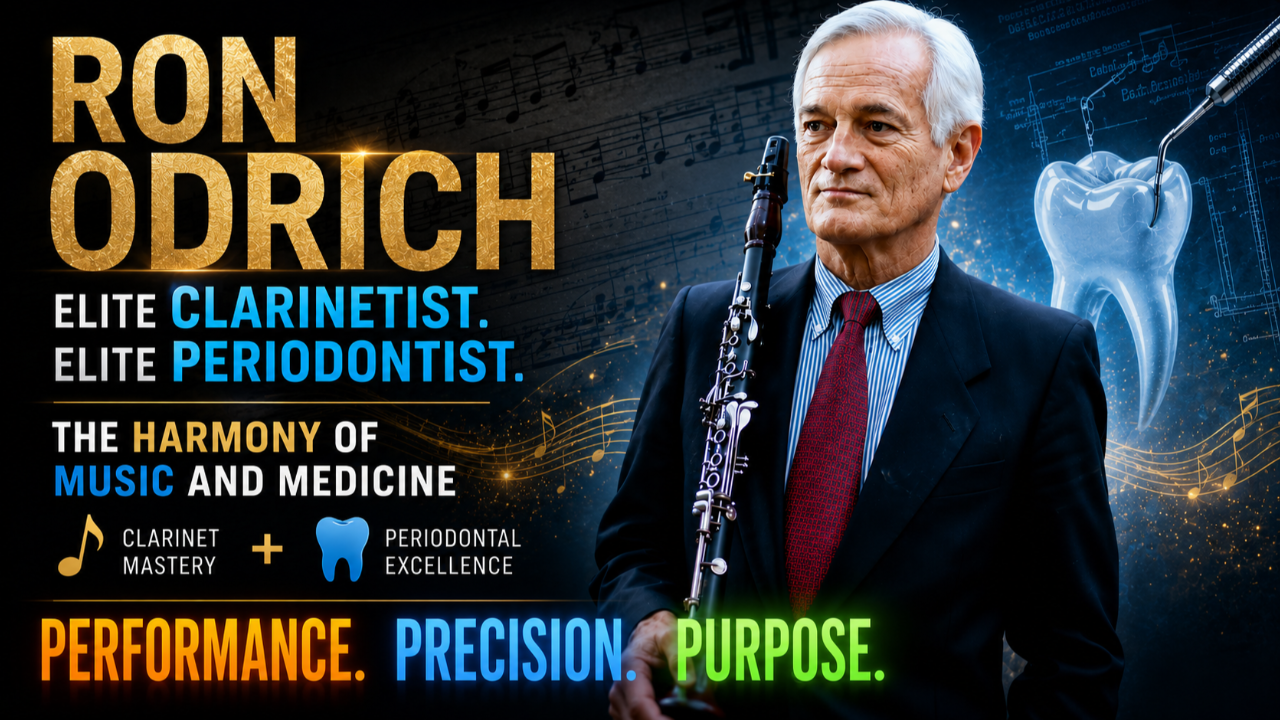
The Science of Clarinet Sound: What Your Mouth Is Really Doing (And Why It Changes Everything)
What if everything you were taught about "blowing" the clarinet was making you sound worse and tenser than you needed to be? In this deep-dive conversation, Ron Ordrich shares the anatomy behind great clarinet tone. Ron is a periodontist and lifelong professional clarinetist who studied with legends like Marcellus and Bonade. This is the science your teachers probably never taught you.
If you enjoy this post, find the conversation on YouTube and Apple podcasts
The #1 Word That's Ruining Clarinet Tone: "Blow"
Ask any beginner (or even intermediate clarinetist) what they do with air, and they'll say: blow. And that single word, Ron Ordrich argues, is one of the most counterproductive instructions in all of wind playing.
"The worst verb you can use for a wind instrument is blow," Ron says. "The better verb is exhale. Sigh into the clarinet."
Here's why the distinction matters physiologically: when you think about blowing like blowing out a candle or blowing across a toy, you engage your sympathetic nervous system. That's the fight-or-flight system. Tension. Constriction. Superior constrictor muscles firing. The very opposite of what creates a resonant, free tone.
When you exhale, taking a long, relaxed, belly-driven release, you activate your parasympathetic nervous system. Relaxation. Openness. Resonance.
"When you play the clarinet, you're ostensibly doing the ideal thing to get yourself into a relaxed mode," Ron explains. "Taking a deep breath and then exhaling slowly. The minute you start blowing, you push yourself into the sympathetic nervous system and everything tightens."
Try this now: Play an open G by exhaling gently into the horn rather than pushing air. Notice how different it sounds and feels compared to your normal approach.
The Hidden Resonating Chamber: Your Soft Palate
Here's something most clarinet teachers never address: unlike most instruments, where sound begins outside the body, the clarinet's sound begins inside your mouth. Your oral cavity is a resonating chamber, and whether that chamber is open or constricted is one of the biggest variables in your tone quality.
The challenge? You can't see inside your own mouth. And telling a student to "open your throat" is, as Ron puts it, nearly meaningless instruction.
"Your throat doesn't open up," he says. "What opens is your oropharynx, the part right behind the back of your tongue. How do you get that? You can't just tell someone to open it up. That's meaningless. But you can tell them what it feels like."
His solution is elegantly reflexive: curl your upper lip over your teeth and pull it back. Don't think about your soft palate. Don't try to "open your throat." Just make that lip movement and observe what happens automatically.
"That reflexively raises the soft palate," Ron says. "It opens up the mouth as a resonating chamber. You're not doing anything. The nervous system takes over."
He recommends this as a practice tool: spend five minutes playing long tones with a double-lip embouchure to lock in the feeling of that open, resonant chamber. Then, when you transition back to your normal embouchure, carry that feeling with you.
Key insight: When you try to consciously "open" your soft palate, you add tension. When you trigger it reflexively through lip position, it relaxes into place. Feeling over force.
How to Breathe Like Pavarotti (Without Looking Like You're Breathing at All)
Ron points to Pavarotti as the gold standard of breath management, and the lesson isn't about volume of air. It's about where the breath goes.
"Watch videos of Pavarotti singing. He sings a whole aria and then takes a deep breath, and nothing moves above the chest. It's all down here." Ron gestures to his belly. "The back expands. The ribs expand. And then you sit upon what you have, because all those muscles have elasticity and they're going to contract."
This is the diaphragmatic breath: belly pushing out, not shoulders rising. And critically, once you've taken that breath, you don't push the air out. You let it out. The compressed air finds its way out in a small, high-velocity stream through the instrument without muscular forcing.
"If you really breathe in and your belly pushes out, and the air comes out in a very small area, there's a lot of velocity," Ron says. "You don't have to push."
The Anatomy of the Embouchure: What Those Muscles Are Actually Doing
Ron is unusual among clarinet teachers in that he can name and explain every muscle involved in embouchure formation. As a periodontist with decades of experience treating wind players, he's spent a career looking inside musicians' mouths and connecting what he sees to what he hears.
A few key muscles every clarinetist should know:
- Orbicularis oris: the circular muscle surrounding the lips; it controls lip tension and seal around the mouthpiece
- Buccinator: the cheek muscle; keeping it firm prevents the puffy-cheeks embouchure
- Mentalis: the chin muscle; it helps anchor the lower lip against the reed
- Risorius: the "smiling muscle" that pulls corners back; generally not what you want
- Zygomaticus major: the muscle that raises lip corners; famously misused by one well-known teacher who told students to engage it while playing. Ron disagrees strongly: "That's pulling the lips back and up. That's not what you want when you play the clarinet."
His point isn't to turn you into an anatomy student. It's to help you understand that muscles only do two things: contract and relax. And if you know which direction a muscle pulls, you know exactly what happens when it fires.
The Truth About "Don't Bite" and What to Think Instead
You've heard it a thousand times: don't bite down on the mouthpiece. Ron agrees with the goal, but not the instruction.
Any time we give an instruction to not do something, we're essentially saying to do it. Our brains are wired that way.
Instead, Ron reframes biting in terms of what you should feel: "Think of it as your lip coming up to caress the reed. Your teeth are just going to sit there. They're structural. When you go up into the upper register, you may exert some additional pressure. But that's not biting. It's support."
The same reframe applies to embouchure pressure in general. Rather than "don't push," the instruction becomes: let the weight of the bell rest the mouthpiece against your upper teeth. That's the amount of contact. Gravity does the work.
Language matters: Replace "don't blow" with "exhale." Replace "don't bite" with "caress the reed." Positive, actionable instructions engage the nervous system differently than negatives.
Your Tongue: The Most Variable and Least Understood Part of Your Embouchure
The tongue is made of eight muscles: four intrinsic (which shape it) and four extrinsic (which move it). It can move forward, backward, side to side, flatten, point, and arch. And unlike almost every other variable in clarinet technique, where the tongue rests and moves is completely invisible to you and to your teacher.
"I've always been impressed by the fact that some players don't know where to put the tongue if you tell them to move it left," Ron says. "They really don't know what to do."
And here's the crucial point he makes that most method books skip entirely: there is no single correct tongue position for everyone. The right tongue position depends on:
- The size and shape of your tongue (wide and flat vs. narrow and thick)
- The shape of your palate (high arch vs. flat; a flat palate leaves less room for tongue arch)
- Your dental anatomy: overjet, overbite, and how the mouthpiece naturally sits against your teeth all shift where the tongue tip naturally contacts the reed
Ron himself tongues with the ventral side (underside) of his tongue tip against the reed, not the top, as is traditionally taught, because of how his jaw and teeth sit. It works for him. The point is: if the standard instruction isn't clicking for you, it may not be a discipline problem. It may be an anatomy mismatch. Experiment with slightly different tongue positions and trust what your ears confirm.
The Feedback Loop: Learning to Feel Good Sound
Perhaps the most transferable insight from Ron's science-informed approach is this: great tone has a physical feeling, and you can learn to recognize it.
"I maintain that there is a feeling that goes along with getting the most resonant sound on the clarinet," he says. "And this is something I don't think is ever taught. If you latch onto what that feels like, exactly what it feels like when you're getting a very resonant sound, because there is a feedback that you get... it's actually physically a very satisfying feeling, because it's within your body."
This is the opposite of teaching by external metrics alone. It's building an internal compass, one that functions even when you're practicing alone at midnight or performing in an unfamiliar acoustic.
The path there: exhale freely, feel the resonance in your oral cavity, notice what's different when the sound opens up versus when it constricts. And then replicate that feeling, not just the finger positions or the notation.
Bringing It All Together
Ron Ordrich's science-based approach to clarinet technique isn't about making playing more complicated. It's about making the instructions more accurate, so that what you practice actually produces the result you're after.
The core principles:
- Exhale, don't blow. Activate your parasympathetic nervous system, not your fight-or-flight response.
- Let the soft palate raise reflexively through lip position rather than trying to "open" anything consciously.
- Breathe from the belly. Let the air's natural elasticity do the work without forcing.
- Caress the reed rather than biting or pressing.
- Find your tongue position based on your own anatomy, not a universal prescription.
- Learn to feel great tone as a physical sensation and use that as your internal feedback system.
This post is based on Episode 2 of the Clarinet Ninja Podcast, a conversation between Jay Hassler and Ron Odrich. Ron is a retired periodontist who studied clarinet with Robert Marcellus and Daniel Bonade, performed with the Airmen of Note, and recorded with Phil Woods and Clark Terry. Jay Hassler is the founder of Clarinet Ninja, offering online lessons and the Clarinet Ninja Dojo for adult players.
Are you an adult clarinetist looking to improve faster and build better habits? Book a free call to learn more about the Clarinet Ninja Dojo.